How x² + 2x + 5 Becomes 2x + 2
Kurtis WeissnatDifferentiate x squared plus 2x plus 5 to 2x plus 2, and see how the derivative measures change.
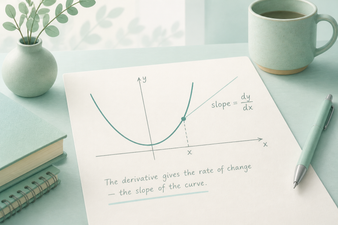
A curve, not a snapshot
Consider the function
f(x) = x² + 2x + 5
For each input x, you get a height on a smooth curve. The value alone says where you are. The derivative says how that height is changing as x moves.
Differentiate term by term
Power rule: d/dx (xⁿ) = n · xⁿ⁻¹. Constants vanish under differentiation.
d/dx (x²) = 2x
d/dx (2x) = 2
d/dx (5)  = 0
Add them:
f'(x) = 2x + 2
So the messy-looking quadratic collapses into a simple line that tracks slope.
What 2x + 2 reveals
At a point x = a, the number f'(a) = 2a + 2 is the instantaneous rate of change of f.
- If
f'(a) > 0, the curve is rising throughx = a. - If
f'(a) < 0, it is falling. - If
f'(a) = 0, the tangent is flat—a candidate peak or valley.
Here f'(x) = 2(x + 1) = 0 when x = -1. Near that point the quadratic bottoms out; elsewhere the sign of 2x + 2 tells you whether f grows or shrinks as x increases.
Change, made precise
The derivative is a limit of average rates:
f'(x) = lim (h → 0) [f(x + h) - f(x)] / h
For our f, that limit evaluates to 2x + 2. Average rise-over-run becomes an exact slope—change without needing a finite step size.
Takeaway
Differentiating x² + 2x + 5 to 2x + 2 is not a magic rewrite. It extracts the curve’s local rate of change and hands it back as a new function you can read, graph, and reason with.

👋 Hey, I'm Katie
I like to write about productivity, web development, design, and working with clients. Get a sense of what it’s like to work with me and understand my process.
Contact Me