Triangles: Angles, Sides, and Balance
Kurtis WeissnatA gentle tour of triangle types, angle sums, and why three sides form the simplest rigid shape.
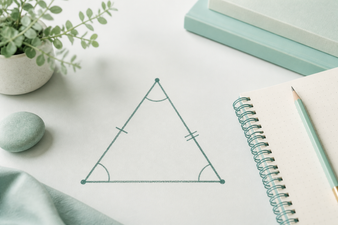
Why triangles matter
A triangle is the simplest closed polygon: three sides, three angles, one region. That simplicity makes it the skeleton of roofs, bridges, and meshes—once three lengths lock, the shape cannot flex without stretching a side.
Angle sum
In Euclidean geometry, the interior angles of any triangle add to a straight angle:
α + β + γ = 180° = π radians
If you know two angles, the third is fixed. That single constraint ties local corner measures to the global shape.
Side relationships
Label the sides opposite angles A, B, and C as a, b, and c. Familiar special cases:
- Equilateral — all sides equal, all angles
60° - Isosceles — two sides equal, base angles equal
- Right — one angle is
90°, and Pythagoras holds:
a² + b² = c²
Area without height drama
When height is awkward to measure, Heron’s formula still works from the three sides alone. With semi-perimeter s = (a + b + c) / 2:
Area = √[s(s - a)(s - b)(s - c)]
Takeaway
Triangles package constraint: angles sum to π, sides decide area and rigidity. Start here, and every later shape is triangles glued together.

👋 Hey, I'm Katie
I like to write about productivity, web development, design, and working with clients. Get a sense of what it’s like to work with me and understand my process.
Contact Me